

Wednesday, June 6, 2012


Wednesday, April 18, 2012
Reblooming Bearded Irises
Reblooming Bearded Irises have existed for
decades. Unlike “Encore®” Reblooming Azaleas, these
special perennial plants received minimal attention from Iris fanciers. Public notice finally arrived in the
late nineties due to a feature story appearing in Martha Steward Living Magazine. Product demand forced major producers to list selections in
their yearly catalogs.
 The Joyce Lockatell
Memorial Garden
The Joyce Lockatell
Memorial Garden
Spring only flowering bearded irises cannot
become a reblooming one.
Remontants (rebloomers) are bred for spring and fall flowering. As hybridizers such as the late Dr. Lloyd Zurbrigg formerly of
Radford, VA and Durham, NC retired, concrete performance data and new
development saw a significant decline over the past decade. Since rebloom origins are difficult to
pinpoint, only a handful of dedicated breeders across the US and Canada are
actively working for new color breaks and patterns plus better fall
reliability. One current goal is
to move the fall bloom sequence up to late August or early September. Such progress would allow gardeners in
colder climates the chance to enjoy these marvelous heirloom plants in fall
flower.
Gardeners should use extreme caution in
ordering plants from mail order catalogs and print media ads. Growers fail to make the distinction
between warm and cool season varieties.
West Coast selections may not grow or flower in fickle Mid-Atlantic
growing conditions. Consult
reputable local growers for the best choices in performance
and fall bloom reliability.
Mike Lockatell
Roots & Blooms,
LLC
 The Joyce Lockatell
Memorial Garden
The Joyce Lockatell
Memorial Garden
500 Pantela Drive
North Chesterfield, VA
23235
(804) 330-2916
rootsandblooms.us
Tuesday, March 6, 2012
The Great Clarence Mystery
Mike has published an article proposing a solution to the "Great Clarence Mystery"--the unknown parentage of one of the most breathtaking of Lloyd Zurbrigg's reblooming irises. "Clarence" was a finalist for the prestigious Dykes Medal, but failed to win it due to uncertain antecedents.
The article was published in "Irises: The Bulletin of the American Iris Society" vol 92(2), April 2011, and appears HERE by permission.
The article was published in "Irises: The Bulletin of the American Iris Society" vol 92(2), April 2011, and appears HERE by permission.
Rebloom Seeks Good Fortune (Published in American Iris Society Region 4 Newscast, March 2012)
Mike's article linked here recently appeared in the March 2012 issue of The Newscast, the newsletter of Region 4 of the American Iris Society.
Winter Weeds on the Attack
A mild winter is a mixed bag. Homeowners have hopefully enjoyed lower heating bills. Landscape contractors and arborists continue to work without the threat of freezing temperatures in an effort to get a jump start on the upcoming spring season.
Since the groundhog in PA made his annual declaration in early February, winter daytime temperatures remain above normal. Winter weeds such as chickweed, henbit, Bittercress and dandelions have been on a rampage in plantings beds and lawns. Bittercress continues to make new appearances in the suburban landscape. Like its fellow noxious broadleaf weeds, gardeners should not ignore its existence in the yard.
Hairy Bittercress (Cardamine hirsuta) germinates and grows into a basil rosette with small dark segmented foliage. It has a mounded appearance composed of pinnate leaves with alternate 1-2-3 parts of round to kidney shapes leaflets. Petioles are prominent and hairy. Flower stems are erect and smooth sporting little foliage.
Small (2-3mm in diameter) white blooms have four tiny petals. They are arranged in dense racemes. (The floral structure is on a smaller scale similar to hyacinth flowers.) Long and narrow purple seed heads can measure up to l.5 cm to 2 cm in length. Its fruit are known as “Siliques” and can explosively spread seed as much as 10 feet from the parent plant. Any contact such as walking, raking, weeding, lawn mowing activates seed dispersal.
Heavy hairy Bittercress infestations are mainly evident in early spring. Home gardeners can easily forget about this broadleaf weed’s presence around the landscape during the remainder of the growing season. Control measures require timely post emergent herbicide applications in spring and fall. This weed’s unique and efficient seed distribution mechanism can NOT be underestimated. If Bittercress infestations are manageable, mechanical removal is highly recommended before and during flowering. The same advice is helpful for henbit, chickweed and annual bluegrass control.
Avid home gardeners are strongly advised to contact your local Cooperative Extension Office to discuss the latest recommendations to curb this aggressive broadleaf weed. Be vigilant now to avoid later pain.
Tuesday, March 8, 2011
Peony Care Starts in Early Spring
Herbaceous peonies are rugged heirloom perennial plants valued for their drought tolerance and deer resistance. Breeders continue to introduce exciting hybrids to the marketplace featuring new color breaks, patterns and flower forms though carefully selected, nature will find any defect.
Hybrid herbaceous peonies flourish in mild springs. Flower durability and longevity translates into a long bloom season. Wet springs punctuated by persistent rainfall are a perfect environment for disease outbreaks. A chemical program begun in early spring as new shoots emerge mitigates future fungal problems.
 |
| Powdery Mildew |
Botrytis blight (Botrytis paeoniae), measles (Cladosporium paeoniae), and powdery mildew (Erisyphe polygoni) fungal spores can easily jump from plant to plant. Heavy winds or rains are great transportation modes for these nasty pathogens. Infection from neighborhood plantings or new garden center purchases is entirely possible. Rather than lamenting over misfortune or exacting blame, know the facts and respond with proper identification and treatment.
Botrytis is the most common peony disease. Symptoms appear in late spring on young leaf shoots about one foot in height. Susceptible center stems wilt and die. A brown or blackish rot appears at the base of leaves and stems. Affected areas of the stalk above ground will be covered by a gray mold filled with large spore populations. Immediate removal and treatment is essential to combat infection.
Peony Measles or “Red Spot” resemble small circular discolored lesions on leaves. Spots can combine to make foliate look irregularly blotched. The under surface of these areas becomes light brown. Different powdery mildew disease species can attack plants in the home and commercial landscape. Native dogwoods and hybrid lilac, honeysuckle, bee balm and zinnias are common hosts for these fungi. Herbaceous peonies have their own powdery mildew specialists that develop as a white film on leaves and stems. Infestation effects are seen in late summer. Protection applied during wet springs mitigates the disease’s devastating visual appearance.
Immunox® (Myclobutanil) is a reliable systemic fungicide labeled for botrytis and peony measles control. Spectracide® packages formulations in one quart containers for tank mixing. The Pest Management Guide from Virginia Cooperative Extension also suggests Ortho® Rosepride® (triforine) for powdery mildew control. Protective sprays should be made during favorable disease conditions as new foliage emerges and matures through spring. A spray for Measles is a good tool immediately following bloom season.
Good garden sanitation is a must. Spent flowers should be immediately removed during bloom season. Remove declining foliage each October. Collected debris should be tossed in the garbage or burned. NO COMPOSTING. Additional advice and information can be obtained from your local Cooperative Extension Office. Please follow product label for mixing and applying registered pesticides. Use a spreader sticker (surfactant) in your spray solution for best results.
 |
| Remove Old Blooms |
Friday, February 25, 2011
Rebloom Searches for Silver Lining (Published in American Iris Society Region 4 Newscast , March 2011)
Rebloom was put to the test this past summer in Region 4. Record heat and dryness wilted many gardeners and their cherished plantings. Prospects for summer and fall flower were dim. Against all odds, consistent rebloom did materialize. Survival had some unexpected pleasant blessings.
The Richmond area saw its hottest summer on record. The National Weather Service considers summer to be June, July and August. The average daily temperature for the three month period was 81.3° F, which eclipsed the previous record of 79.6° F posted in 1900!!
Meager summer rainfall added to the misery. Only 5.93 inches were recorded during the span. Summers with drier readings were 4.46 inches in 1921 and 5.24 inches in 1912. Lack of rainfall was one factor contributing to abnormal summer warmth according to a meteorologist interviewed by Rex Springsten for the Richmond Times Dispatch.
 The bleak growing conditions however did not discourage rebloom in my garden. My daily diary indicates summer flower began appearing during the second week of June. SDBs Double Overtime (Tasco, 2004) and Sailboat Bay (Zurbrigg, 2001) kicked off the early parade TBs Summer Radiance (Wilkerson, 1996), Anxious (Hager, 1992), Durham Dream (Zurbrigg, 2000) and Northward Ho (Zurbrigg, 1991) flowered on multiple bloomstalks until crushing heat arrived in early July.
July heat was oppressive. Daytime temperatures frequently hovered between 90° F and 100° F. As August approached, rebloom suddenly reappeared on both named varieties and seedlings. ‘Northward Ho’ without any prodding resumed summer flowering. The strawberry pink plicata has now turned in solid summer rebloom in consecutive years. A combination of ‘Northward Ho’ and Double Vision (Ghio, 1999) has produced children with summer and early September flowering. They had performed well during the same time frame in 2009. It was encouraging to see similar
results under more challenging conditions during the past year.
The big surprise in August was finding bloomstalks on offspring featuring Gate of Heaven (Zurbrigg, 2004) mated with Zurbrigg Seedling Nos.# TT109 and 20360A-L. The extreme growing conditions clearly affected stalk height, branching and flower quality. An important Zurbrigg breeding goal was to develop reliable late summer and early September remontants. The performance of both ‘Northward Ho” and ‘Gate of Heaven’ seedlings in my garden indicates future rebloomers can acquire this valuable genetic trait.
Lois Rose from Partlow, VA has dedicated a large portion of her bearded iris plantings to remontants. The FAIS member has worked with me over the years to use her garden results as an important check against mine in Powhatan, VA. We strive to test new selections and chart rebloom consistency on well known varieties. Micro climate quirks still confound our best intentions. Lois however was able to water, so she did have good fall results despite Dante’s Inferno. Outstanding rebloom was obtained during September on IB Low Ho Silver (Byers, 1989). The white median had a whopping eight plus stalks through October. The late Sterling Innerst’s tall bearded rebloomers turned in solid efforts. Lois recorded four stalks on Again and Again (Innerst, 1999), seven on Lunar Whitewash (Innerst, 2003) and six on Over and Over (Innerst, 2000). Sterling effectively used Hager, Hall, Mahan and Zurbrigg breeding to create a rich rebloom
legacy to benefit both iris gardeners and future breeders.
Solid September-October median performers were SDBs Rosalie Loving (Spoon, 2003) and ‘Sailboat Bay’, IB Tawny (Pray, 1974), BB September Buttercup (G.P.Brown, 1962) and MTB Lady Emma (F.P. Jones, 1986). Maryland Ho (Hornstein, 2003) was an exceptional Region 4 origination. A tall bearded plicata out of ‘Northward Ho’, it produced four stalks during the period. Past Zurbrigg TB favorites also did well. Earl of Essex (Zurbrigg, 1980), I Do (Zurbrigg, 1974), Jennifer Rebecca (Zurbrigg, 1985), Renown Zurbrigg, 1992) and Youth Dew (Zurbrigg, 1980) had an average of three bloomstalks per clump. The late Bernice Miller’s ‘Born Again’ (1977) was a prolific fall bloomer. The dark crimson bitone tall bearded had seven stalks!!

FAIS president Doug Chyz and member Sue Shackleford filed encouraging reports. Doug found median bloom on SDBs Blueberry Tart (Chapman, 2002), Giggler (Spoon, 2001), Pretty Girl (Spoon, 2001), Sky Willow (Spoon, 2004) and Smell the Roses (Byers, 1988). He also reported fall bloom on TBs Queen Dorothy (Hall, 1984) and Witch of Endor (B. Miller, 1978).
The Shackleford garden had rebloom on both older and recent releases. Four recent tall bearded introductions from Kentucky remontant breeder Betty Wilkerson made the grade. Fall flower occurred on Another Bridge (Wilkerson, 2005), Echo Location (Zurbrigg, 2007), Star Gate (Wilkerson, 2005) and Tara’s Choice (Wilkerson, 2004). Zurbrigg releases re-
blooming for Sue were Clarence (Zurbrigg, 1991), ‘Earl of Essex’, English Cottage (Zurbrigg, 1976) and ‘Gate of Heaven’. Innerst TBs mentioned were ‘Again and Again’ & Lunar Whitewash. Older selections in fall flower were TBs Buckwheat (Byers, 1989), Istanbul (Byers, 1990), Rosalie Figge (McKnew, 1991) and ‘Queen Dorothy’.
CVIS members reported the following fall bloom in their November 2010 Newsletter. June and John Rosini had June rebloom on IB Double Your Fun (Aitken, 2000). Other median rebloom in their garden was Plum Wine (Weiler, 1986) and MTB ‘Lady Emma’. TBs Perfume Counter (Zurbrigg, 1972) and Iceland (Byers, 1991) reached fall flower. A number of additional remontants had developing stalks and buds. Jim Diggs enjoyed rebloom on TB (Daughter of Stars, 2000) and Shirley Shelton had multiple fall bloom on ‘Again and Again’.
Don Rude from Blacksburg, VA saw rebloom on ‘Gate of Heaven’ for a month. Initial flowering started on September 1st. Don also saw fall bloom on TBs Mango Parfait (Spoon, 2008) and Frost Echo (Aitken, 1995). Linoa Adams from Raleigh, NC had November/December flowering on TB Matrix (Hall by Zurbrigg, 1992).
 Extreme summer heat and drought for the most part delayed bloomstalk formation on most reliable rebloomers until the latter stages of October throughout Region 4 in 2010. Hard frosts started materializing in the beginning of November damaging most developing stalks. This report tried to focus on reports of actual bloom. We still however appreciate any emerging fall bloomstalk reporting. This information is still tabulated and available to any interested member or rebloom breeder. Results indicate many recent introductions seem to be consistent in any weather condition. Lets focus on the positives in an otherwise brutal year. If some of the current reporting trends continue, rebloom still has a great future ahead of it.
The Richmond area saw its hottest summer on record. The National Weather Service considers summer to be June, July and August. The average daily temperature for the three month period was 81.3° F, which eclipsed the previous record of 79.6° F posted in 1900!!
Meager summer rainfall added to the misery. Only 5.93 inches were recorded during the span. Summers with drier readings were 4.46 inches in 1921 and 5.24 inches in 1912. Lack of rainfall was one factor contributing to abnormal summer warmth according to a meteorologist interviewed by Rex Springsten for the Richmond Times Dispatch.

July heat was oppressive. Daytime temperatures frequently hovered between 90° F and 100° F. As August approached, rebloom suddenly reappeared on both named varieties and seedlings. ‘Northward Ho’ without any prodding resumed summer flowering. The strawberry pink plicata has now turned in solid summer rebloom in consecutive years. A combination of ‘Northward Ho’ and Double Vision (Ghio, 1999) has produced children with summer and early September flowering. They had performed well during the same time frame in 2009. It was encouraging to see similar
results under more challenging conditions during the past year.
The big surprise in August was finding bloomstalks on offspring featuring Gate of Heaven (Zurbrigg, 2004) mated with Zurbrigg Seedling Nos.# TT109 and 20360A-L. The extreme growing conditions clearly affected stalk height, branching and flower quality. An important Zurbrigg breeding goal was to develop reliable late summer and early September remontants. The performance of both ‘Northward Ho” and ‘Gate of Heaven’ seedlings in my garden indicates future rebloomers can acquire this valuable genetic trait.
Lois Rose from Partlow, VA has dedicated a large portion of her bearded iris plantings to remontants. The FAIS member has worked with me over the years to use her garden results as an important check against mine in Powhatan, VA. We strive to test new selections and chart rebloom consistency on well known varieties. Micro climate quirks still confound our best intentions. Lois however was able to water, so she did have good fall results despite Dante’s Inferno. Outstanding rebloom was obtained during September on IB Low Ho Silver (Byers, 1989). The white median had a whopping eight plus stalks through October. The late Sterling Innerst’s tall bearded rebloomers turned in solid efforts. Lois recorded four stalks on Again and Again (Innerst, 1999), seven on Lunar Whitewash (Innerst, 2003) and six on Over and Over (Innerst, 2000). Sterling effectively used Hager, Hall, Mahan and Zurbrigg breeding to create a rich rebloom
legacy to benefit both iris gardeners and future breeders.
Solid September-October median performers were SDBs Rosalie Loving (Spoon, 2003) and ‘Sailboat Bay’, IB Tawny (Pray, 1974), BB September Buttercup (G.P.Brown, 1962) and MTB Lady Emma (F.P. Jones, 1986). Maryland Ho (Hornstein, 2003) was an exceptional Region 4 origination. A tall bearded plicata out of ‘Northward Ho’, it produced four stalks during the period. Past Zurbrigg TB favorites also did well. Earl of Essex (Zurbrigg, 1980), I Do (Zurbrigg, 1974), Jennifer Rebecca (Zurbrigg, 1985), Renown Zurbrigg, 1992) and Youth Dew (Zurbrigg, 1980) had an average of three bloomstalks per clump. The late Bernice Miller’s ‘Born Again’ (1977) was a prolific fall bloomer. The dark crimson bitone tall bearded had seven stalks!!
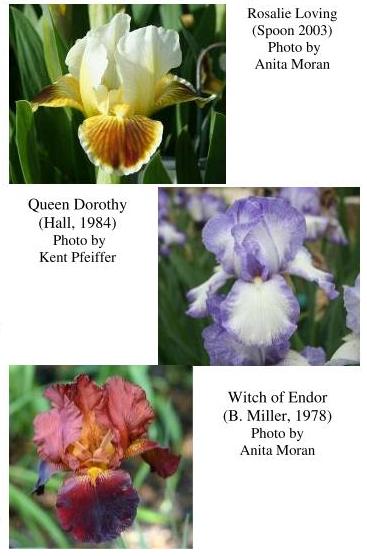
FAIS president Doug Chyz and member Sue Shackleford filed encouraging reports. Doug found median bloom on SDBs Blueberry Tart (Chapman, 2002), Giggler (Spoon, 2001), Pretty Girl (Spoon, 2001), Sky Willow (Spoon, 2004) and Smell the Roses (Byers, 1988). He also reported fall bloom on TBs Queen Dorothy (Hall, 1984) and Witch of Endor (B. Miller, 1978).
The Shackleford garden had rebloom on both older and recent releases. Four recent tall bearded introductions from Kentucky remontant breeder Betty Wilkerson made the grade. Fall flower occurred on Another Bridge (Wilkerson, 2005), Echo Location (Zurbrigg, 2007), Star Gate (Wilkerson, 2005) and Tara’s Choice (Wilkerson, 2004). Zurbrigg releases re-
blooming for Sue were Clarence (Zurbrigg, 1991), ‘Earl of Essex’, English Cottage (Zurbrigg, 1976) and ‘Gate of Heaven’. Innerst TBs mentioned were ‘Again and Again’ & Lunar Whitewash. Older selections in fall flower were TBs Buckwheat (Byers, 1989), Istanbul (Byers, 1990), Rosalie Figge (McKnew, 1991) and ‘Queen Dorothy’.
CVIS members reported the following fall bloom in their November 2010 Newsletter. June and John Rosini had June rebloom on IB Double Your Fun (Aitken, 2000). Other median rebloom in their garden was Plum Wine (Weiler, 1986) and MTB ‘Lady Emma’. TBs Perfume Counter (Zurbrigg, 1972) and Iceland (Byers, 1991) reached fall flower. A number of additional remontants had developing stalks and buds. Jim Diggs enjoyed rebloom on TB (Daughter of Stars, 2000) and Shirley Shelton had multiple fall bloom on ‘Again and Again’.
Don Rude from Blacksburg, VA saw rebloom on ‘Gate of Heaven’ for a month. Initial flowering started on September 1st. Don also saw fall bloom on TBs Mango Parfait (Spoon, 2008) and Frost Echo (Aitken, 1995). Linoa Adams from Raleigh, NC had November/December flowering on TB Matrix (Hall by Zurbrigg, 1992).

Subscribe to:
Comments (Atom)