Saturday, March 23, 2013

New Insect Pests Threatening Bearded Iris by Michael Lockatell

First published in Newscast, Region Four of the American Iris Society, Vol 47, No. 1, March 2005.  Used with permission

Bearded irises are tough customers in the growing space. Novice gardeners will plant rhizomes in any blank space around the yard. Site selection can be problematic, but this perennial's persistence in any growing condition is a testament to the plant's durability. Plant foliage makes bearded irises impervious to frequent deer invasions in ever expanding suburban landscapes. Despite their charm and endurance, new threats are materializing to challenge the modern hybrid's standing in today's perennial borders.


It is important to be aware of disease and insect pests plaguing our modern bearded hybrids. The same suspects on the disease side continue to put pressure on healthy clumps particularly in abnormally wet growing seasons. Insect pests have remained the same for decades, but nature has recently added some new twists to keep us on our toes. 

We can expect iris borer larvae to emerge right after bloom season. Their life cycle doesn't vary too much from year to year. Good garden sanitation has proven to be very effective on their overall control by removing all dead foliage on clumps during late fall, winter and early spring. We entirely avoided insecticide application due to thorough garden cleanup and daily IPM scouting. Not one to tempt fate, a residual insecticide spray will be planned as a backup measure to combat any unforeseen infestations this summer. 


Salt marsh caterpillar (Estigmene acrea) or yellow whollybear, is an entirely different adversary. Its existence in a given geographical area can be tied to previous farm activity. Soybeans are a host for these pests along with a number of vegetable crops. A recent report from Maryland indicates salt marsh caterpillars were feeding on fall pansy crops. They readily adapt to secondary hosts, primarily perennial weeds. 


My garden is located in a portion of a twenty acre field being used for hay production and Christmas trees. Soybeans may have been part of a crop rotation plan for the ground during its days as a working farm. Farming is long gone. These pests adapted by feeding on field weeds like dogbane. They therefore migrate from other sections of this site to feed on my iris plantings. These insect pests have multiple generations during spring and summer, so Integrated Pest Management scouting is crucial to plan on effective insecticide remedy to keep them at bay. 


Larvae are covered with dense soft setae (hairs) of variable length. Body color is extremely variable, from pale yellow to black. (1) "Full grown caterpillars are about two to two and one half inches long. The have a reddish brown body that may be difficult to see because of the long black hairs that cover the entire body. (2) These fur balls look like rich black brillo pads in my garden display beds. I have discovered examples of this stage of development in February in landscape plantings. 


Salt marsh caterpillars over winter as larvae in a protected place. They prepare inside a silk cocoon interwoven with the long hairs from their body. Adult moths appear in early spring. Their wing is about two inches, but their front wings are milk white. Male hind wings are yellow-orange, while the female's hind wings remain milk white. Both adults can be identified by a peppering of irregular black spots in front and hind wings. 
(2) 

Iris growers should always be scouting for salt marsh caterpillar adult moths each spring. Their appearance starts the next cycle, and plans for control measures should be considered. Female moths lay large masses of eggs on host plants. Larvae can be observed crawling rapidly across the ground, lawns or roads to find targets for their dining pleasure. If encountered, young caterpillars will curl up and play dead.

Yellow whollybear damage can be extensive on any planting of bearded or Siberian irises. They seem to like feeding later in the day. These monsters prefer chewing on tender new plant tissue. The caterpillar will climb to the top of the iris fan. They pick an individual leaf and begin feeding from the tip working towards the rhizome. A quarter of each leaf is usually consumed before moving on to another healthy fan. Another favorite tactic of these pests is chewing a gaping hole in the center leaf at the mid point of a given fan. Damage on a one fan seedling could be fatal or stunt future increase for months. If yellow whollybears are not seen on the upper portions of the iris fans, try inspecting the center of the clumps along the ground for their existence and potential feeding damage.  

Unlike salt marsh caterpillars, yellow striped army worm (Spodoptera ornithogalli) has one generation to scout for bearded iris defoliation. As an iris breeder, these pests are a major threat to any healthy first year seedling bed. Most of their feeding damage is done at ground level. One of their favorite modes of attack is sawing off just emerged side increases. They also like to eat a gaping hole in the center leaf of the fan near the rhizomes. The succulent leaf tissue of these sites is easy for the yellow striped army worm to digest, so newly divided plantings are equally at risk of a late summer attack. 

The life cycle for yellow striped armyworm averages 30 days during summer months depending on temperature. These pests can have four generations per year, but they seem to be active in my garden from late July through the month of August. Larvae (worms or technically known as instars) are the dangerous stage of the life cycle. They will appear dark to velvety black with a yellow or light colored band running down each side of the back. A black spot can be observed on each side of the abdominal segment. Adult worms can measure up to 50mm long.  

Foliar damage occurs during the last three instars of larval development. Host plant research indicated defoliation during this span is 5, 16 and 77%. Observations at my garden reveal substantial feeding can take place in a matter of days. After the yellow striped armyworm passes through the larval instar, it pupates about 1-3 inches deep into the soil to over winter. Pupae emerge in the spring to mature as adult moths. 


They have a wingspan of 30-35mm with a very complex color pattern on the fore wings. Eggs are laid in masses from 50 to several hundred. They are then covered with gray scales from the female moth. Armyworm populations are considerably larger during cool, wet springs followed by warm humid summers. Since Central Virginia has experienced these weather conditions in recent years, iris gardeners should be scouting their gardens for these pests by the beginning of June. 


Insecticide remedies vary for salt marsh caterpillars (yellow whollybear) and yellow striped armyworm. They have proven to be immune to applications of Imida Chloprid used for iris borer control. Contact your local Cooperative Extension Service office for the latest control recommendations for these insect pests. Always use a spreader sticker to keep formulations on target foliage. A residual spray application is your best option. Rotate insecticides and always read the product label before any application.
A special thanks to Dr. David Holdhouser soybean specialist, Virginia Polytechnic Institute and State University for his technical assistance in the preparation of this article
Reference:

  1. Insect of the Month May 2004 Salt-marsh caterpillar. Seen at http://www.pestnetwork.com/insectofmo/iotmmay04.html 
  2. Holshouser, David L., soybean specialist, Virginia Polytechnic Institute and State University (personal communi-cation). Written communication on salt-marsh caterpillar and yellow striped armyworm. 
  3. Highley, L.G. and Boethel, J. 1994. Handbook of Soybean Insects. Entomological Society of America, Lanham MD, 38-41. 
  4. Highley, L.G. and Boethel, J. 1994. Handbook of Soybean Insects. Entomological Society of America, Lanham MD, 102. 

Monday, March 11, 2013

A Tribute to My Mentor

First published in Newscast, Region Four of the American Iris Society, Vol 47, No. 1, March 2005.  Used with permission

It is hard to imagine spring iris bloom without Lloyd Zurbrigg. His tutelage over the past five plus years has enabled me to develop a love for growing, creating and evaluating Siberian and bearded irises for the perennial garden.

My late mother's favorite garden plants were irises and herbaceous peonies. Thanks to plantings at my aunt and uncle's home and the guidance of long time growers Ethelene and Charles Gray, the attention of this landscape professional began to focus on bearded irises. The Grays' display gardens at their home in my hometown of Montvale, N.J. were chock full of the best spring blooming tall bearded selections on the iris scene. My new interest in these hardy perennials finally resulted in the establishment of drifts of these eye catching plants in front yard beds at my parents new home in Richmond, Virginia.

After coming to Richmond in 1996, I eventually joined the local chapter of the American Iris Society. Carolyn and I attended the AIS Region 4 Spring Meeting in Towson, Maryland in 1998. Aussie breeder Barry Blyth was the headline speaker at that event, but we always remember a tall and handsome gentleman on the two day tour surveying irises at each garden stop wearing his signature white safari hat.

Our next encounter with Lloyd would be back in Richmond. He gave a program at a CVIS winter meeting on the latest developments in his various breeding lines. He showed two slide trays worth of interesting seedlings, so Carolyn and I decided to come to Durham, N. C. to see his garden in spring bloom. It was an overwhelming experience for two first time visitors. We saw row after row of predominantly white blooms with various shadings of yellow on the fall shoulders thanks to the constant use of MESMERIZER, RENOWN and SUNNY SHOULDERS. After a few hours of his patient reciting of seedling numbers and parentages from his black ringed stud book, our heads were literally spinning!! It would take me a few years to easily recognize the parents and merits for instance of 0026, 0032C, 0033 and MASTERWORK.

The coming of the new millennium soon transformed a casual association into a close friendship centered on the further development of his legendary breeding lines. We finally convinced Lloyd to visit my garden in spring 02. Carolyn picked him up at the train station, and his initial reaction to seeing the garden was priceless. "I never expected anything like this!!" It was a joy of a lifetime having him walk through each iris row with me. We evaluated my first crop of seedlings and countless named varieties. He was interviewed by a local newspaper reporter and watched proudly as a film crew taped a segment for my appearance on a local public television gardening show. Doc adorned in a iris apron and armed with a pair of tweezers and a box of pollen envelopes from seedlings and named varieties growing in his own garden, he had the rare luxury of having two bloom seasons to make crosses. Plans began in earnest to bring some of his older seedlings from Durham to Richmond for evaluation and further breeding.
Dr. Lloyd Zurbrigg and Mike Lockatell


Photo: Photo: Lloyd Zurbrigg and Mike Lockatell Spring 2004, Courtesy of Mike Lockatell

We would share two more springs together evaluating old and new seedlings, making crosses and looking for new ideas to try in the future. Carolyn and I cherished the time Lloyd spent with us each spring. We finally decided to have the living room piano tuned before his 04 visits. We shared memorable moments of music and song each night before dinner. The sheet music for a song composed by one of wife Nita's music students, still resides on the music holder waiting for Doc to play it on his next visit.

My second crop of seedlings bloomed for the first time this past spring and fall. The best ones for rebloom featured Zurbrigg breeding lines as part of the parentages. Spring flowering saw unseasonably hot temperatures, but he nonetheless spent equal time looking at and breeding with hopefuls from both of our lines. Carolyn noted his satisfaction with our progress, and he spoke highly of his W72 seedlings in his last contribution for the Reblooming Iris Robin.

I brought bloomstalks from two of his older seedlings to the Region 4 Fall Flower Show in Fredericksburg. Even though neither one won top honors in the seedling division, PP36 and RR39 received a lot of favorable attention at the meeting. Lloyd came to Richmond for a final time to see my garden in fall bloom. His health had worsened since spring, but he found enough resolve to spend two days with us and to look at three of his older rebloom seedlings PP61 , SS111 and SS129 in full bloom. A couple of additional fall hopefuls were unfortunately still in bud stage, but we had great fun speculating on their eventual bloom. We agreed, at the time, there was nothing to introduce, but some of our seedlings had lots of breeding potential.

News soon indicated Lloyd had an inoperable malignant tumor on his liver. His condition began to deteriorate, and he was unable to write a contribution to the latest round of the Reblooming Iris Robin. I ended up composing a report for both of us highlighting the best fall rebloom in years for Central Virginia and Region 4. It was ironic I would soon get sick too, and my subsequent recuperation prevented me from seeing him one last time. Photo: Lloyd

Sunday, February 10, 2013

Rebloom visits Austin

By Mike Lockatell, AIS Region 4 Reblooming Iris Chairman

Reblooming bearded iris culture can be a frustrating experience. Fall flowering traits are still not well understood. Weather and micro-climates can dramatically alter yearly results. Some varieties are so fickle, soil types can drive success or failure. Rebloom breeders end up using instincts to make their best combinations each spring to obtain more reliable offspring to flourish in any growing condition....

Click on thumbnail for full text of article


Thursday, September 13, 2012

A New Script for Rebloom
By Mike Lockatell, AIS Region 4 Reblooming Iris Chairman

Click HERE for the full text of the article (pdf)

American Iris Society Region 4—The Newscast August 2012 p. 10-11

Wednesday, April 18, 2012

Reblooming Bearded Irises

Reblooming Bearded Irises have existed for decades.  Unlike “Encore®” Reblooming Azaleas, these special perennial plants received minimal attention from Iris fanciers.  Public notice finally arrived in the late nineties due to a feature story appearing in Martha Steward Living Magazine.  Product demand forced major producers to list selections in their yearly catalogs.

Spring only flowering bearded irises cannot become a reblooming one.  Remontants (rebloomers) are bred for spring and fall flowering.  As hybridizers such as the late Dr. Lloyd Zurbrigg formerly of Radford, VA and Durham, NC retired, concrete performance data and new development saw a significant decline over the past decade.  Since rebloom origins are difficult to pinpoint, only a handful of dedicated breeders across the US and Canada are actively working for new color breaks and patterns plus better fall reliability.  One current goal is to move the fall bloom sequence up to late August or early September.  Such progress would allow gardeners in colder climates the chance to enjoy these marvelous heirloom plants in fall flower.

Gardeners should use extreme caution in ordering plants from mail order catalogs and print media ads.  Growers fail to make the distinction between warm and cool season varieties.  West Coast selections may not grow or flower in fickle Mid-Atlantic growing conditions.  Consult reputable local growers for the best choices in performance and fall bloom reliability.

Mike Lockatell                                            
Roots & Blooms, LLC                                   
The Joyce Lockatell Memorial Garden
500 Pantela Drive
North Chesterfield, VA 23235
(804) 330-2916
rootsandblooms.us


Tuesday, March 6, 2012

The Great Clarence Mystery

Mike has published an article proposing a solution to the "Great Clarence Mystery"--the unknown parentage of one of the most breathtaking of Lloyd Zurbrigg's reblooming irises. "Clarence" was a finalist for the prestigious Dykes Medal, but failed to win it due to uncertain antecedents.

The article was published in "Irises: The Bulletin of the American Iris Society" vol 92(2), April 2011, and appears HERE by permission.

Rebloom Seeks Good Fortune (Published in American Iris Society Region 4 Newscast, March 2012)

Mike's article linked here recently appeared in the March 2012 issue of The Newscast,  the newsletter of Region 4 of the American Iris Society.

Winter Weeds on the Attack

A mild winter is a mixed bag.  Homeowners have hopefully enjoyed lower heating bills.  Landscape contractors and arborists continue to work without the threat of freezing temperatures in an effort to get a jump start on the upcoming spring season. 
Since the groundhog in PA made his annual declaration in early February, winter daytime temperatures remain above normal.  Winter weeds such as chickweed, henbit, Bittercress and dandelions have been on a rampage in plantings beds and lawns.  Bittercress continues to make new appearances in the suburban landscape.  Like its fellow noxious broadleaf weeds, gardeners should not ignore its existence in the yard. 
Hairy Bittercress (Cardamine hirsuta) germinates and grows into a basil rosette with small dark segmented foliage.  It has a mounded appearance composed of pinnate leaves with alternate 1-2-3 parts of round to kidney shapes leaflets.  Petioles are prominent and hairy.  Flower stems are erect and smooth sporting little foliage.
Small (2-3mm in diameter) white blooms have four tiny petals.  They are arranged in dense racemes.  (The floral structure is on a smaller scale similar to hyacinth flowers.)  Long and narrow purple seed heads can measure up to l.5 cm to 2 cm in length.  Its fruit are known as “Siliques” and can explosively spread seed as much as 10 feet from the parent plant.  Any contact such as walking, raking, weeding, lawn mowing activates seed dispersal. 
Heavy hairy Bittercress infestations are mainly evident in early spring.  Home gardeners can easily forget about this broadleaf weed’s presence around the landscape during the remainder of the growing season. Control measures require timely post emergent herbicide applications in spring and fall.  This weed’s unique and efficient seed distribution mechanism can NOT be underestimated.  If Bittercress infestations are manageable, mechanical removal is highly recommended before and during flowering.  The same advice is helpful for henbit, chickweed and annual bluegrass control. 
Avid home gardeners are strongly advised to contact your local Cooperative Extension Office to discuss the latest recommendations to curb this aggressive broadleaf weed.  Be vigilant now to avoid later pain. 

Tuesday, March 8, 2011

Peony Care Starts in Early Spring

Herbaceous peonies are rugged heirloom perennial plants valued for their drought tolerance and deer resistance.  Breeders continue to introduce exciting hybrids to the marketplace featuring new color breaks, patterns and flower forms though carefully selected, nature will find any defect.

Hybrid herbaceous peonies flourish in mild springs.  Flower durability and longevity translates into a long bloom season.  Wet springs punctuated by persistent rainfall are a perfect environment for disease outbreaks. A chemical program begun in early spring as new shoots emerge mitigates future fungal problems. 

Powdery Mildew
Botrytis blight (Botrytis paeoniae), measles (Cladosporium paeoniae), and powdery mildew (Erisyphe polygoni) fungal spores can easily jump from plant to plant.  Heavy winds or rains are great transportation modes for these nasty pathogens.  Infection from neighborhood plantings or new garden center purchases is entirely possible.  Rather than lamenting over misfortune or exacting blame, know the facts and respond with proper identification and treatment. 

Botrytis is the most common peony disease.  Symptoms appear in late spring on young leaf shoots about one foot in height.  Susceptible center stems wilt and die.  A brown or blackish rot appears at the base of leaves and stems.  Affected areas of the stalk above ground will be covered by a gray mold filled with large spore populations.  Immediate removal and treatment is essential to combat infection.

Peony Measles or “Red Spot” resemble small circular discolored lesions on leaves.  Spots can combine to make foliate look irregularly blotched.  The under surface of these areas becomes light brown.  Different powdery mildew disease species can attack plants in the home and commercial landscape.  Native dogwoods and hybrid lilac, honeysuckle, bee balm and zinnias are common hosts for these fungi.  Herbaceous peonies have their own powdery mildew specialists that develop as a white film on leaves and stems.  Infestation effects are seen in late summer.  Protection applied during wet springs mitigates the disease’s devastating visual appearance.

Immunox® (Myclobutanil) is a reliable systemic fungicide labeled for botrytis and peony measles control.  Spectracide® packages formulations in one quart containers for tank mixing.  The Pest Management Guide from Virginia Cooperative Extension also suggests Ortho® Rosepride® (triforine) for powdery mildew control.  Protective sprays should be made during favorable disease conditions as new foliage emerges and matures through spring.  A spray for Measles is a good tool immediately following bloom season. 

Remove Old Blooms
 Good garden sanitation is a must.  Spent flowers should be immediately removed during bloom season.  Remove declining foliage each October.  Collected debris should be tossed in the garbage or burned.  NO COMPOSTING.  Additional advice and information can be obtained from your local Cooperative Extension Office.  Please follow product label for mixing and applying registered pesticides.  Use a spreader sticker (surfactant) in your spray solution for best results. 


Friday, February 25, 2011

Rebloom Searches for Silver Lining (Published in American Iris Society Region 4 Newscast , March 2011)

Rebloom was put to the test this past summer in Region 4. Record heat and dryness wilted many gardeners and their cherished plantings. Prospects for summer and fall flower were dim. Against all odds, consistent rebloom did materialize. Survival had some unexpected pleasant blessings.

The Richmond area saw its hottest summer on record. The National Weather Service considers summer to be June, July and August. The average daily temperature for the three month period was 81.3° F, which eclipsed the previous record of 79.6° F posted in 1900!! 

Meager summer rainfall added to the misery. Only 5.93 inches were recorded during the span. Summers with drier readings were 4.46 inches in 1921 and 5.24 inches in 1912. Lack of rainfall was one factor contributing to abnormal summer warmth according to a meteorologist interviewed by Rex Springsten for the Richmond Times Dispatch.

The bleak growing conditions however did not discourage rebloom in my garden. My daily diary indicates summer flower began appearing during the second week of June. SDBs Double Overtime (Tasco, 2004) and Sailboat Bay (Zurbrigg, 2001) kicked off the early parade TBs Summer Radiance (Wilkerson, 1996), Anxious (Hager, 1992), Durham Dream (Zurbrigg, 2000) and Northward Ho (Zurbrigg, 1991) flowered on multiple bloomstalks until crushing heat arrived in early July.

July heat was oppressive. Daytime temperatures frequently hovered between 90° F and 100° F. As August approached, rebloom suddenly reappeared on both named varieties and seedlings. ‘Northward Ho’ without any prodding resumed summer flowering.  The strawberry pink plicata has now turned in solid summer rebloom in consecutive years.  A combination of ‘Northward Ho’ and Double Vision (Ghio, 1999) has produced children with summer and early September flowering. They had performed well during the same time frame in 2009. It was encouraging to see similar
results under more challenging conditions during the past year.

The big surprise in August was finding bloomstalks on offspring featuring Gate of Heaven (Zurbrigg, 2004) mated with Zurbrigg Seedling Nos.# TT109 and 20360A-L. The extreme growing conditions clearly affected stalk height, branching and flower quality. An important Zurbrigg breeding goal was to develop reliable late summer and early September remontants. The performance of both ‘Northward Ho” and ‘Gate of Heaven’ seedlings in my garden indicates future rebloomers can acquire this valuable genetic trait.

Lois Rose from Partlow, VA has dedicated a large portion of her bearded iris plantings to remontants. The FAIS member has worked with me over the years to use her garden results as an important check against mine in Powhatan, VA. We strive to test new selections and chart rebloom consistency on well known varieties. Micro climate quirks still confound our best intentions. Lois however was able to water, so she did have good fall results despite Dante’s Inferno. Outstanding rebloom was obtained during September on IB Low Ho Silver (Byers, 1989). The white median had a whopping eight plus stalks through October. The late Sterling Innerst’s tall bearded rebloomers turned in solid efforts. Lois recorded four stalks on Again and Again (Innerst, 1999), seven on Lunar Whitewash (Innerst, 2003) and six on Over and Over (Innerst, 2000). Sterling effectively used Hager, Hall, Mahan and Zurbrigg breeding to create a rich rebloom
legacy to benefit both iris gardeners and future breeders.

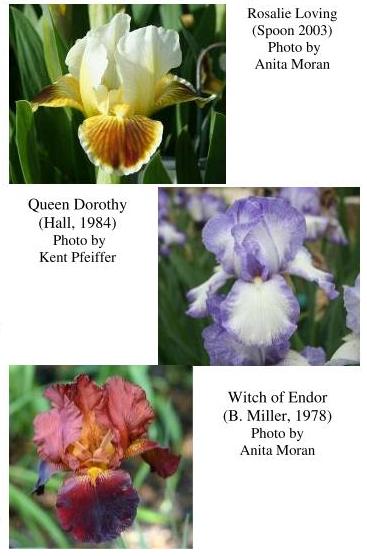
Solid September-October median performers were SDBs Rosalie Loving (Spoon, 2003) and ‘Sailboat Bay’, IB Tawny (Pray, 1974), BB September Buttercup (G.P.Brown, 1962) and MTB Lady Emma (F.P. Jones, 1986). Maryland Ho (Hornstein, 2003) was an exceptional Region 4 origination. A tall bearded plicata out of ‘Northward Ho’, it produced four stalks during the period. Past Zurbrigg TB favorites also did well. Earl of Essex (Zurbrigg, 1980), I Do (Zurbrigg, 1974), Jennifer Rebecca (Zurbrigg, 1985), Renown Zurbrigg, 1992) and Youth Dew (Zurbrigg, 1980) had an average of three bloomstalks per clump. The late Bernice Miller’s ‘Born Again’ (1977) was a prolific fall bloomer. The dark crimson bitone tall bearded had seven stalks!!

FAIS president Doug Chyz and member Sue Shackleford filed encouraging reports. Doug found median bloom on SDBs Blueberry Tart (Chapman, 2002), Giggler (Spoon, 2001), Pretty Girl (Spoon, 2001), Sky Willow (Spoon, 2004) and Smell the Roses (Byers, 1988). He also reported fall bloom on TBs Queen Dorothy (Hall, 1984) and Witch of Endor (B. Miller, 1978).

The Shackleford garden had rebloom on both older and recent releases. Four recent tall bearded introductions from Kentucky remontant breeder Betty Wilkerson made the grade. Fall flower occurred on Another Bridge (Wilkerson, 2005), Echo Location (Zurbrigg, 2007), Star Gate (Wilkerson, 2005) and Tara’s Choice (Wilkerson, 2004). Zurbrigg releases re-
blooming for Sue were Clarence (Zurbrigg, 1991), ‘Earl of Essex’, English Cottage (Zurbrigg, 1976) and ‘Gate of Heaven’. Innerst TBs mentioned were ‘Again and Again’ & Lunar Whitewash. Older selections in fall flower were TBs Buckwheat (Byers, 1989), Istanbul (Byers, 1990), Rosalie Figge (McKnew, 1991) and ‘Queen Dorothy’. 

CVIS members reported the following fall bloom in their November 2010 Newsletter. June and John Rosini had June rebloom on IB Double Your Fun (Aitken, 2000). Other median rebloom in their garden was Plum Wine (Weiler, 1986) and MTB ‘Lady Emma’. TBs Perfume Counter (Zurbrigg, 1972) and Iceland (Byers, 1991) reached fall flower. A number of additional remontants had developing stalks and buds. Jim Diggs enjoyed rebloom on TB (Daughter of Stars, 2000) and Shirley Shelton had multiple fall bloom on ‘Again and Again’. 

Don Rude from Blacksburg, VA saw rebloom on ‘Gate of Heaven’ for a month. Initial flowering started on September 1st. Don also saw fall bloom on TBs Mango Parfait (Spoon, 2008) and Frost Echo (Aitken, 1995). Linoa Adams from Raleigh, NC had November/December flowering on TB Matrix (Hall by Zurbrigg, 1992). 

Extreme summer heat and drought for the most part delayed bloomstalk formation on most reliable rebloomers until the latter stages of October throughout Region 4 in 2010. Hard frosts started materializing in the beginning of November damaging most developing stalks. This report tried to focus on reports of actual bloom. We still however appreciate any emerging fall bloomstalk reporting. This information is still tabulated and available to any interested member or rebloom breeder. Results indicate many recent introductions seem to be consistent in any weather condition. Lets focus on the positives in an otherwise brutal year.  If some of the current reporting trends continue, rebloom still has a great future ahead of it.

Thursday, September 30, 2010

Rebloom Finds Favor in Kansas City Area by Mike Lockatell – Richmond, VA

The heirloom perennials in my grandmother’s garden have survived the test of time. One of her favorite plants was bearded iris, though she always had trouble keeping the lawn and weeds away from the rhizomes. Spring blooms always made the yard sparkle in late May and early June. She was likely unaware there were bearded irises capable of giving her a second chance at bloom each fall.

The late Dr. Lloyd Zurbrigg worked for decades to popularize reblooming or remontant bearded irises. The trait was originally traced to median breeding development. The big problem was obtaining both modern flower form and reliability in the class. The use of West Coast originations by Clarence Mahan, Earl Hall, Jane McKnew, Dr. Zurbrigg and others led to a number of reliable Eastern tall bearded rebloom introductions with improved flower form in the early nineties. The public and AIS judges would soon take notice.

‘Clarence’ (TB 91) was the best of Doc Zurbrigg’s early nineties releases. Flowers featured white standards tinted violet. Falls were light blue violet with a white center and hafts. A sweet fragrance completed the package. Named for Clarence Mahan, a former AIS president, it was the first tall bearded reliable rebloomer to be a finalist for the Dykes Medal. The eastern remontant’s unknown parentage has been the subject of countless speculation over the years. One of its offspring, ‘Daughter of Stars’ (D. Spoon, 00) is currently a finalist for the Dykes Medal on the 2010 AIS National Ballot.

‘Matrix’ (TB, Hall, 91), ‘Rosalie Figge’ (TB, McKnew, 93) and ‘Renown’ (TB, Zurbrigg, 92) have West Coast lineage in them. Schreiner breeding for black, for instance, involved the use of Iris aphylla. Its presence in Dykes Medalist ‘Titan’s Glory’ (TB, Schreiner, 81) coupled with ‘Violet Miracle’ (TB, Zurbrigg, 79)
created the McKnew tall bearded rebloomer with impeccable flower form and coloring. ‘Rosalie Figge’ is still the best reliable purple remontant on the market to date. The possible influence of I. aphylla in the parentage is also finally leading to work to trace its impact on rebloom.

Rebloom breeders for the most part took their cue from Zurbrigg releases. The late Monty Byers used a number of Doc’s introductions for his groundbreaking rebloom program. Working out of California, Byers also weaved the late Ben Hager’s rebloom influences into his breeding lines. Many of his early nineties originations are still widely grown and used in current breeding.

Sterling Innerst, another Eastern breeder from Gettysburg, PA used both Zurbrigg and Hager remontants to create selections with good form and dynamite reliability. ‘Again and Again’ (99), a medium yellow and ‘Over and Over’ (00), a light lavender plicata are a pair of tall beardeds turning in summer and early fall rebloom in my garden. These Innerst introductions have big, blocky flower forms making them attractive for future breeding ideas. Their potential stud worth is still largely untapped.

Betty Wilkerson, a long time Kentucky rebloom advocate, has begun releasing a number of important tall bearded remontants. Her best effort so far seems to be ‘Echo Location’ (07). Pale yellow flowers have reddish brown haft lines around bright yellow beards. A product of ‘Innocent Star’ and ‘Rebound’, this overlooked Eastern TB faithfully initiates its heavy fall bloom sequence in mid to late September for me.

‘Just Call Me (Wilkerson, 08), another tall bearded rebloomer with ‘Clarence’ heritage, has turned in outstanding early fall bloom in consecutive years. Standards are white and falls have a pale blue wash with lots of ruffles. ‘Love Lines’ (Wilkerson, 06) is the pod parent for this enchanting remontant. Each parent gave its offspring their best traits. ‘Just Call Me’ may indeed have a charmed future for breeders and growers alike.

‘Stargate’ (02), ‘Radiant Bliss’ (06) and ‘Tara’s Choice’ (03) are other recent Wilkerson TB introductions with October flowers in my Central Virginia garden. ‘Radiant Bliss’ may have the best chance to succeed in colder climates. The Kentucky origination features greyed orange standards. Falls have white ground with beetroot and gold plicata overlay. Three-year clumps had a wealth of stalks and flowers beginning in late September in Zone 6. Further, garden testing will determine whether its 2009 performance was a fluke or a trend.

Mike Lockatell with Debbie Hughes during his 2010 visit
Two recent Zurbrigg tall bearded, rebloomers may play to a larger gardening audience. Both releases have received little fanfare but they continue to provide consistent reliable early fall flower in Zone 6. ‘Gate of Heaven’ (04) was nearly lost in its introduction year. Thankfully, Doc sent it to my Powhatan, VA garden for testing and further breeding. Another child of ‘Clarence’, its medium blue coloring can be blue violet during its fall bloom sequence. A garden iris, my breeding mentor’s final introduction has been an outstanding early September performer for me. A convention guest, it rebloomed in Jim Murrain’s suburban Kansas City garden last year.

Zurbrigg’s ‘Twilight Fancies’ (01) is another tall bearded remontant receiving little notice for its reliable rebloom prowess in my area. One of its parents is ‘Iceland’ (Byers, 91). The white and pale blue tall bearded rebloomer from California turned in outstanding early fall results in Region 4 gardens in 2009. ‘Twilight Fancies’ has received ‘Iceland’s’ best traits. A blue neglecta, rebloom performance mirrors its parent in my garden.

Due to a lack of serious promotion and scant breeding development, rebloom’s worth has not been realized in colder climates of the Continental US. Late spring and summer night temperatures below 60o F drive fall flower. If plants have received adequate fertilization and watering, good fall bloom dramatically improves. Rebloom is still not an exact science. Recent study is contributing new clues to the behavior of the rebloom sequence.

My visit to Kansas City and St. Joseph in late March was an opportunity for an Eastern breeder to plead rebloom’s case in our nation’s heartland. Thank you to Greater Kansas City Iris Society and Pony Express Iris Society for your wonderful hospitality and fellowship during my March visit. Rebloom has its place in iris culture.

Add your vote to mine as we advocate its value to a larger gardening audience.

From the AIS Region 18 Fall 2010 Bulletin

Monday, September 27, 2010

Lockatell Wins VA State Fair Design Contest

Mike Lockatell, owner of Roots & Blooms, LLC was judged the winner of the Richmond Times Dispatch sponsored Newspaper Box Garden Design Contest held on Thursday, September 23rd at the State Fair of Virginia in Caroline County. Mike’s winning design and planting stressed low maintenance, deer resistance and drought tolerance. Perennial plants featured in the 5’x5’ display were reblooming iris, herbaceous peony and various euphorbia, sedum and ornamental grass varieties. Reblooming IrisesLunar Whitewash and Rosalie Figge were in bloom during the judging. Lockatell’s winning entry can be seen at the State Fair daily thru October 3rd at the Meadow Event Park. Visit www.statefair.com for more information.
Newspaper box sites are usually hot spots in the home landscape. Close proximity to the street absorbs radiated heat. Soils are usually baked and compacted. Any planting list for such spots should focus on drought tolerance. Perennials are an excellent choice to create a lasting impression for these difficult areas.
Heucheras (Coral Bells) display a dazzling array of foliage colors. Heuchera “Plum Pudding” contributed a red accent to neighboring plant selections. Ornamental grass offer color, texture and interesting fall seedheads. Pennisetum “Hamelin Dwarf” and “Little Bunny,” Fescue “Elijah Blue” and Carex testacea “Praire Fire” provided a nice balance to my design.
The planting also highlighted my work with herbaceous peonies and reblooming irises. Both heirloom perennials are drought tolerant and deer resistant.Reblooming irises initiate two distinct bloom sequences in the same growing season. Lunar Whitewash (ruffled white) and Rosalie Figge (purple with black satin finish on falls) were in flower at judging time. Despite a short flowering period each spring, Peonies offer a great foliage backdrop for any mixed planting border during the growing season.
   
Sedum, Santolina, Euphorbia, Coreopsis and Clematis are the remaining plant elements to mention. Sedum spectabile “Autumn Joy” and “Neon” are valued for their drought tolerance and timely September bloom. Santolina “Virens Green” is a superb perennial herb with fragrance, foliage and flower. It has shown exceptional resilience dealing with recent extreme weather. Euphorbia “Red Martin, Tasmanian Tiger and Ascot Rainbow” added further foliage color, texture and height to the design. Clematis “Blue Ravine” is the top choice in vines to cover mailboxes. It can be easily trained to adorn any structure. Ornate seedheads and fall foliage color are further benefits to using this popular perennial.
   
Newspaper box sites are a fantastic excuse to establish an eye catching perennial display for either sun or shade in the home landscape. My winning entry for the VA State Fair dealt with a sunny exposure. There are dynamite perennials for shade too!! Make a plant list, and create your own awarding winning mailbox design.